
Traditional Banking vs AI Native Banking is no longer just a technology upgrade topic it represents a complete shift in how financial services are designed, delivered, and experienced in the digital era.
Introduction
Over the past decade, banking has transformed rapidly. Customers today don’t compare their bank only with another bank; they compare it with every seamless digital experience they interact with whether it’s shopping online, ordering food, or streaming content. This has raised expectations for speed, personalization, and intelligence in every financial interaction.
While traditional digital transformation helped banks move services online, it is no longer enough in today’s competitive landscape. The real disruption is happening with AI Native Banking, where intelligence is embedded into every process from customer onboarding and fraud detection to decision-making and personalized financial guidance.
That is where AI Native Banking enters the picture.
Unlike traditional banking systems that simply add artificial intelligence as an extra feature, AI Native Banking is built with intelligence at its core. Every customer interaction, operational workflow, fraud detection process, lending decision, and personalization capability is enhanced through AI-driven automation and data intelligence.
As financial institutions face increasing customer expectations, stricter regulations, rising operational costs, and growing competition from fintech companies, choosing between traditional banking architecture and AI-first banking has become a strategic business decision not just a technology upgrade.
In this guide, you’ll learn
- What Traditional Banking really means today
- What AI Native Banking is
- The key differences between both models
- Real-world banking use cases
- Benefits and challenges of each approach
- Why many financial institutions are shifting toward AI-first banking in 2026 and beyond
Whether you’re a banking executive, fintech founder, digital transformation leader, or technology decision-maker, this comparison will help you understand where the industry is heading and how to prepare your organization for the next generation of financial services.
Understanding Traditional Banking
Traditional banking refers to financial institutions that primarily operate on legacy infrastructure and established banking processes. While many banks have introduced mobile apps and digital services, much of their core technology still relies on systems built years or even decades ago.
These banks often deliver reliable financial services but face increasing pressure to innovate faster without disrupting existing operations.
Typical characteristics include
- Legacy core banking systems
- Rule-based decision making
- Manual approvals for many processes
- Department-specific data silos
- Limited personalization
- Longer product development cycles
Traditional banking remains highly trusted and continues to serve millions of customers worldwide. However, maintaining legacy systems while meeting modern customer expectations has become increasingly expensive and complex.
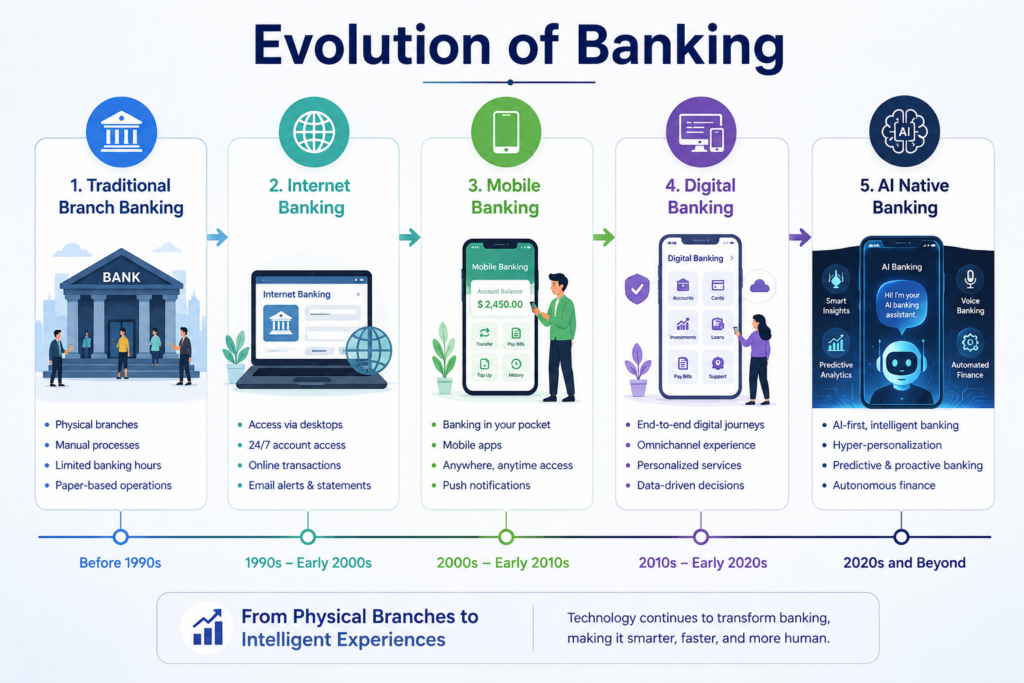
Digital banking does not automatically mean AI Native Banking.
Many institutions offer excellent mobile experiences while still relying on decades-old backend systems. AI Native Banking goes much deeper by embedding intelligence into the bank’s operating model rather than simply improving the customer interface.
What Is AI Native Banking?
AI Native Banking represents a new generation of banking platforms where artificial intelligence is integrated into the foundation of business operations rather than added later as a standalone tool.
Instead of asking, “Where can we use AI?”
AI Native organizations ask, “How should this entire banking process work if AI is available from the beginning?”
This shift changes everything—from customer onboarding and fraud detection to lending decisions, compliance monitoring, customer support, treasury management, and financial insights.
Key capabilities often include:
- Intelligent automation
- Predictive analytics
- Real-time fraud monitoring
- AI-powered customer support
- Personalized financial recommendations
- Automated compliance checks
- Continuous risk assessment
- Natural language interfaces
- Decision intelligence
Rather than replacing employees, AI Native Banking allows teams to focus on strategic, customer-focused, and high-value work while AI handles repetitive, data-intensive tasks.
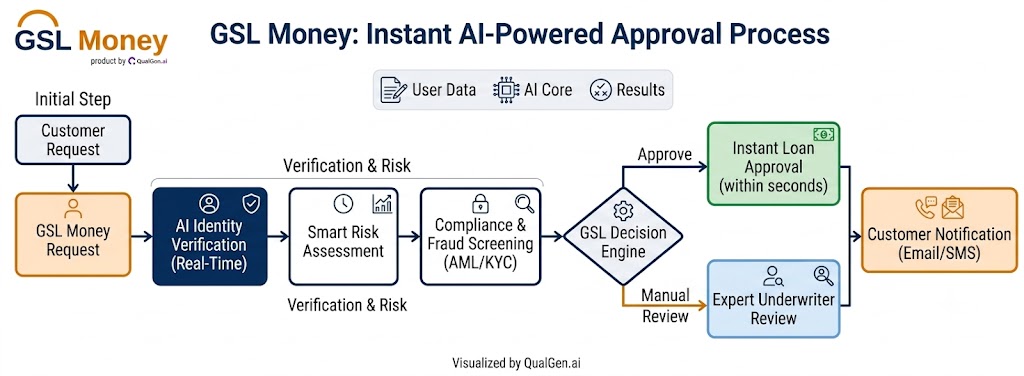
Traditional Banking vs AI Native Banking: Quick Comparison
Comparison Table
| Feature | Traditional Banking | AI Native Banking |
|---|---|---|
| Core Infrastructure | Legacy systems | AI-first architecture |
| Customer Experience | Standardized | Highly personalized |
| Decision Making | Rule-based | AI-driven insights |
| Fraud Detection | Reactive | Predictive & real-time |
| Loan Processing | Manual + rules | Intelligent automation |
| Customer Support | Human-first | AI + Human collaboration |
| Product Innovation | Slow | Rapid experimentation |
| Data Usage | Historical reporting | Real-time intelligence |
| Operational Efficiency | Moderate | High |
| Scalability | Limited by legacy systems | Cloud-ready and scalable |
Traditional Banking focuses on digitizing existing processes.
AI Native Banking reimagines those processes from the ground up using artificial intelligence, automation, and real-time data.
Core Differences Explained
1. Technology Foundation
Traditional banks often build new digital services around existing core systems. While this approach reduces disruption, it can make innovation slower.
AI Native Banking platforms are designed with modern cloud architectures, APIs, and AI services from day one, enabling faster development and easier integration.
2. Customer Experience
Customers increasingly expect personalized recommendations, instant responses, and seamless digital journeys.
Traditional systems generally provide similar experiences for all customers.
AI Native Banking adapts experiences based on customer behavior, financial goals, transaction history, and preferences.
3. Decision Making
Legacy banking relies heavily on predefined business rules and manual approvals.
AI Native Banking enhances decision-making using machine learning models, predictive analytics, and continuously updated risk signals.
This allows institutions to make faster, more informed decisions while maintaining governance and regulatory controls.
4. Operational Efficiency
Many traditional banking workflows still involve repetitive manual tasks.
Examples include:
- Document verification
- Compliance reviews
- Loan assessments
- Customer onboarding
- Internal reporting
AI-powered automation reduces processing time, improves consistency, and enables employees to focus on higher-value work.
Did You Know?
According to industry research from organisations such as McKinsey, Deloitte, and IBM, financial institutions are increasingly investing in AI to improve operational efficiency, strengthen fraud detection, enhance customer experience, and accelerate digital transformation initiatives.
Is your financial institution preparing for the AI-first future?
QualGenAI helps banks, fintech companies, and financial institutions explore practical AI adoption strategies from intelligent automation to AI-powered customer experiences while aligning with regulatory and business objectives.
Benefits of AI Native Banking
AI Native Banking isn’t just about adopting artificial intelligence – it represents a fundamental shift in how financial institutions operate, innovate, and serve customers. By embedding AI into core banking processes, banks can improve efficiency, strengthen security, and deliver highly personalized customer experiences.
1. Faster Decision-Making
Traditional banking often requires multiple manual reviews before approving loans, opening accounts, or processing high-value transactions.
AI-powered decision engines can analyze customer data, credit history, fraud signals, and regulatory requirements within seconds, allowing banks to make faster and more informed decisions.
Business Impact
- Reduced processing time
- Improved customer satisfaction
- Faster loan approvals
- Better operational efficiency
2. Personalized Customer Experiences
Modern customers expect their bank to understand their financial needs.
AI enables banks to provide:
- Personalized savings recommendations
- Smart budgeting insights
- Investment suggestions
- Tailored loan offers
- Relevant financial alerts
Instead of offering identical services to every customer, AI Native Banking creates individualized experiences based on customer behavior and preferences.

3. Stronger Fraud Detection
Fraud has become increasingly sophisticated.
Traditional rule-based fraud systems often identify suspicious activity only after predefined thresholds are met.
AI models continuously learn from transaction patterns and customer behavior, enabling banks to identify unusual activities in real time.
This proactive approach helps reduce financial losses while minimizing false alerts that inconvenience legitimate customers.
The most effective fraud prevention strategies combine AI with human expertise. AI identifies patterns quickly, while experienced fraud analysts investigate complex or high-risk cases.
Real-World Use Cases of AI Native Banking
AI Native Banking is already transforming financial services across multiple business functions.
Intelligent Customer Onboarding
Opening a bank account traditionally involved multiple manual verification steps.
AI-powered onboarding can streamline this process by:
- Verifying identity documents
- Detecting fraudulent IDs
- Performing Know Your Customer (KYC) checks
- Conducting Anti-Money Laundering (AML) screenings
- Assessing customer risk

AI-Powered Lending
Traditional lending relies heavily on historical credit scores and manual underwriting.
AI can analyze a broader range of data, including transaction history, spending behavior, income patterns, and repayment capacity, helping banks make more accurate lending decisions.
Benefits
- Faster approvals
- Better risk management
- Improved customer experience
- Lower operational costs
Customer Support with AI
Customers increasingly expect immediate assistance.
AI-powered virtual assistants can handle common requests such as:
- Balance inquiries
- Card blocking
- Transaction tracking
- Loan information
- Payment status
- Account updates
Complex or sensitive issues can then be transferred seamlessly to human support teams.
This hybrid model improves efficiency while maintaining a high-quality customer experience.
Compliance Automation
Regulatory compliance remains one of the most resource-intensive areas for financial institutions.
AI can assist by:
- Monitoring transactions
- Flagging suspicious activity
- Automating compliance reports
- Detecting policy violations
- Supporting audit preparation
While AI improves efficiency, final compliance decisions should remain under appropriate human oversight to meet regulatory expectations.
Traditional Banking vs AI Native Banking: Decision Matrix
| Business Goal | Traditional Banking | AI Native Banking |
|---|---|---|
| Faster Loan Processing | ⭐⭐ | ⭐⭐⭐⭐⭐ |
| Personalized Banking | ⭐⭐ | ⭐⭐⭐⭐⭐ |
| Fraud Detection | ⭐⭐⭐ | ⭐⭐⭐⭐⭐ |
| Operational Efficiency | ⭐⭐⭐ | ⭐⭐⭐⭐⭐ |
| Customer Experience | ⭐⭐⭐ | ⭐⭐⭐⭐⭐ |
| Innovation Speed | ⭐⭐ | ⭐⭐⭐⭐⭐ |
| Regulatory Reporting | ⭐⭐⭐ | ⭐⭐⭐⭐ |
| Scalability | ⭐⭐ | ⭐⭐⭐⭐⭐ |
Traditional Banking offers stability and established processes, while AI Native Banking provides greater agility, automation, and scalability. For many institutions, the future lies in combining trusted banking practices with AI-driven innovation.
Challenges of Moving to AI Native Banking
Transitioning to AI Native Banking is a strategic journey – not just a technology project.
Financial institutions should carefully consider the following challenges.
Legacy Infrastructure
Many banks operate mission-critical systems that have evolved over decades.
Replacing or modernizing these systems requires careful planning to avoid disrupting customer services.
Data Quality
AI performs best when trained on accurate, consistent, and well-governed data.
Banks often need to address:
- Duplicate records
- Inconsistent formats
- Data silos
- Missing information
A strong data governance framework is essential before scaling AI initiatives.
Regulatory Compliance
Financial institutions operate in one of the world’s most regulated industries.
As AI adoption increases, banks must ensure:
- Transparent decision-making
- Fairness
- Explainability
- Data privacy
- Human oversight where required
Responsible AI governance helps maintain customer trust while meeting evolving regulatory expectations.
Workforce Transformation
AI is changing how banking teams work.
Rather than replacing employees, successful institutions invest in:
- AI literacy
- Upskilling programs
- Human-AI collaboration
- Process redesign
Employees remain central to relationship management, strategic decision-making, and regulatory accountability.
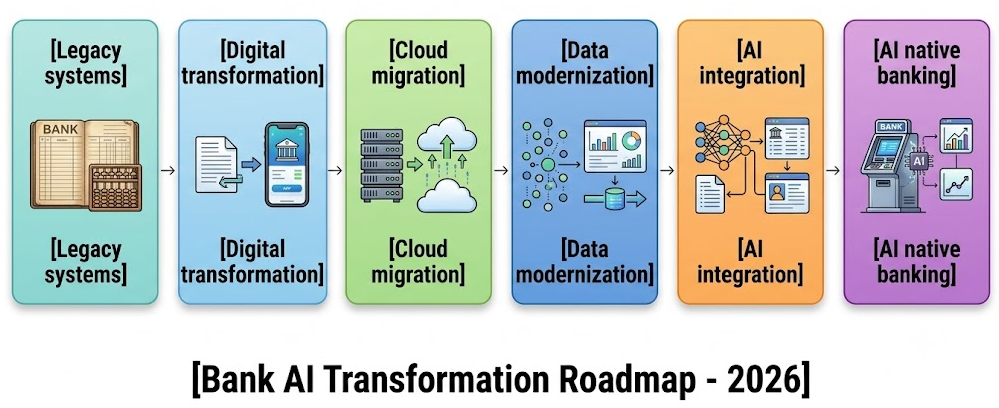
Why Financial Institutions Are Investing in AI
Banks are increasingly adopting AI to address several industry-wide priorities:
- Improving operational efficiency
- Enhancing customer experience
- Strengthening fraud prevention
- Supporting compliance processes
- Accelerating innovation
- Reducing repetitive manual work
- Enabling data-driven decision-making
Organizations such as IBM, Deloitte, McKinsey, and the World Economic Forum have consistently highlighted AI as a key driver of future financial services transformation.
The question is no longer “Should banks use AI?”
The more relevant question is: “How can banks implement AI responsibly while maintaining customer trust, security, and regulatory compliance?”
Institutions that answer this well are more likely to remain competitive in the years ahead.
Ready to Explore AI-Driven Banking?
Whether you’re modernizing legacy systems, improving customer experiences, or evaluating enterprise AI solutions, having a clear strategy is essential.
QualGenAI works with financial institutions to identify practical AI opportunities, streamline banking operations, and build intelligent digital experiences aligned with business and regulatory goals.
Connect with QualGenAI to discuss how AI can support your banking transformation journey.
The Future of Banking (2026–2030)
The banking industry is entering a new phase where artificial intelligence will become a foundational capability rather than a competitive advantage. Over the next few years, financial institutions are expected to move beyond isolated AI pilots toward enterprise-wide AI adoption that improves operations, customer experiences, and decision-making.
Rather than replacing traditional banking entirely, AI Native Banking is likely to evolve alongside it. Many established banks will modernize their core systems while integrating AI into key business processes, creating a hybrid model that combines trust, regulatory compliance, and intelligent automation.
Key Trends Shaping the Future of Banking
1. Hyper-Personalized Banking
Banks will increasingly use AI to deliver financial experiences tailored to individual customers. Instead of offering the same products to everyone, institutions will recommend services based on spending habits, life events, and financial goals.
2. Real-Time Risk Management
AI systems will continuously monitor transactions, customer behavior, and emerging threats, enabling banks to detect risks faster and respond proactively.
3. Responsible AI Governance
As AI adoption grows, explainability, fairness, transparency, and human oversight will become essential. Financial institutions that establish strong AI governance frameworks will be better positioned to meet regulatory expectations and maintain customer trust.
4. Intelligent Automation Across Operations
Routine tasks such as document processing, compliance checks, customer onboarding, and internal reporting will become increasingly automated, allowing employees to focus on strategic and customer-facing activities.
5. Embedded AI Experiences
Customers will interact with AI naturally through chat interfaces, voice assistants, and intelligent financial recommendations integrated into everyday banking experiences.
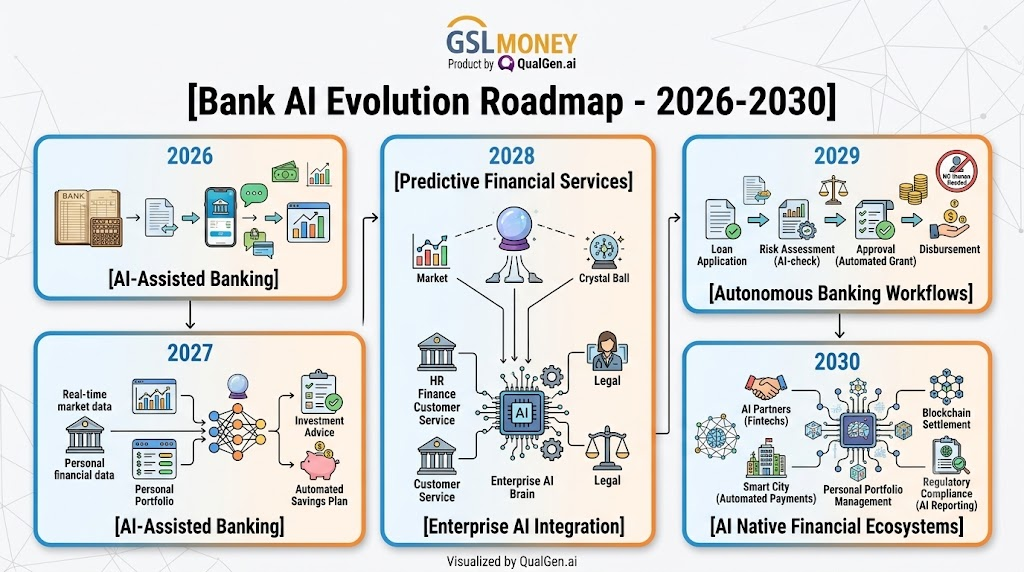
Traditional Banking vs AI Native Banking
Which Model Is Better?
There is no one-size-fits-all answer.
Traditional Banking continues to provide stability, regulatory maturity, and trusted financial services. It remains an essential foundation for many institutions.
AI Native Banking, on the other hand, offers significant advantages in areas such as automation, customer experience, fraud detection, and operational efficiency.
For most financial institutions, the practical path forward is not choosing one over the other – it is modernizing existing capabilities while strategically integrating AI into core banking operations.
Banks that successfully balance innovation with governance are likely to be better prepared for future customer expectations and evolving regulatory requirements.
Ready to Explore AI in Banking?
Whether you’re evaluating AI opportunities, modernizing legacy systems, or building intelligent banking experiences, a clear strategy is the foundation of successful transformation.
QualGenAI partners with banks, fintech companies, and financial institutions to help identify practical AI use cases, accelerate digital transformation, and design AI-powered solutions aligned with business goals and regulatory expectations.
Contact QualGenAI to start your AI transformation journey.
Follow QualGenAI on LinkedIn for expert insights on AI, banking, fintech innovation, and enterprise digital transformation.
Key Takeaways
- Traditional Banking relies heavily on legacy infrastructure and established processes.
- AI Native Banking embeds intelligence into every stage of banking operations.
- AI can improve customer experiences, operational efficiency, and decision-making when implemented responsibly.
- Successful AI adoption requires high-quality data, strong governance, regulatory compliance, and skilled teams.
- The future of banking is expected to combine trusted financial expertise with intelligent automation
Frequently Asked Questions (FAQ)
What is AI Native Banking?
AI Native Banking is a banking model where artificial intelligence is built into core business processes, enabling intelligent automation, real-time decision-making, and personalized customer experiences.
How is AI Native Banking different from Digital Banking?
Digital Banking focuses on delivering banking services through digital channels such as mobile apps and websites.
AI Native Banking goes further by embedding AI into decision-making, fraud detection, operations, compliance, and customer engagement.
Is AI Native Banking replacing Traditional Banking?
No.
Most financial institutions are adopting AI gradually while continuing to operate existing banking systems. AI complements traditional banking rather than replacing it overnight.
Is AI safe for banking?
AI can improve fraud detection, risk management, and operational efficiency. However, financial institutions should implement AI responsibly with appropriate governance, transparency, data security, and human oversight.
Will AI replace bank employees?
AI is more likely to automate repetitive tasks than replace banking professionals. Human expertise remains essential for customer relationships, complex decision-making, compliance, and strategic planning.
Can small financial institutions adopt AI?
Yes.
Many cloud-based AI solutions allow regional banks, credit unions, and fintech companies to adopt AI incrementally without replacing their entire technology stack.
What challenges do banks face when adopting AI?
Common challenges include:
- Legacy infrastructure
- Data quality
- Regulatory compliance
- Workforce transformation
- AI governance
- Change management